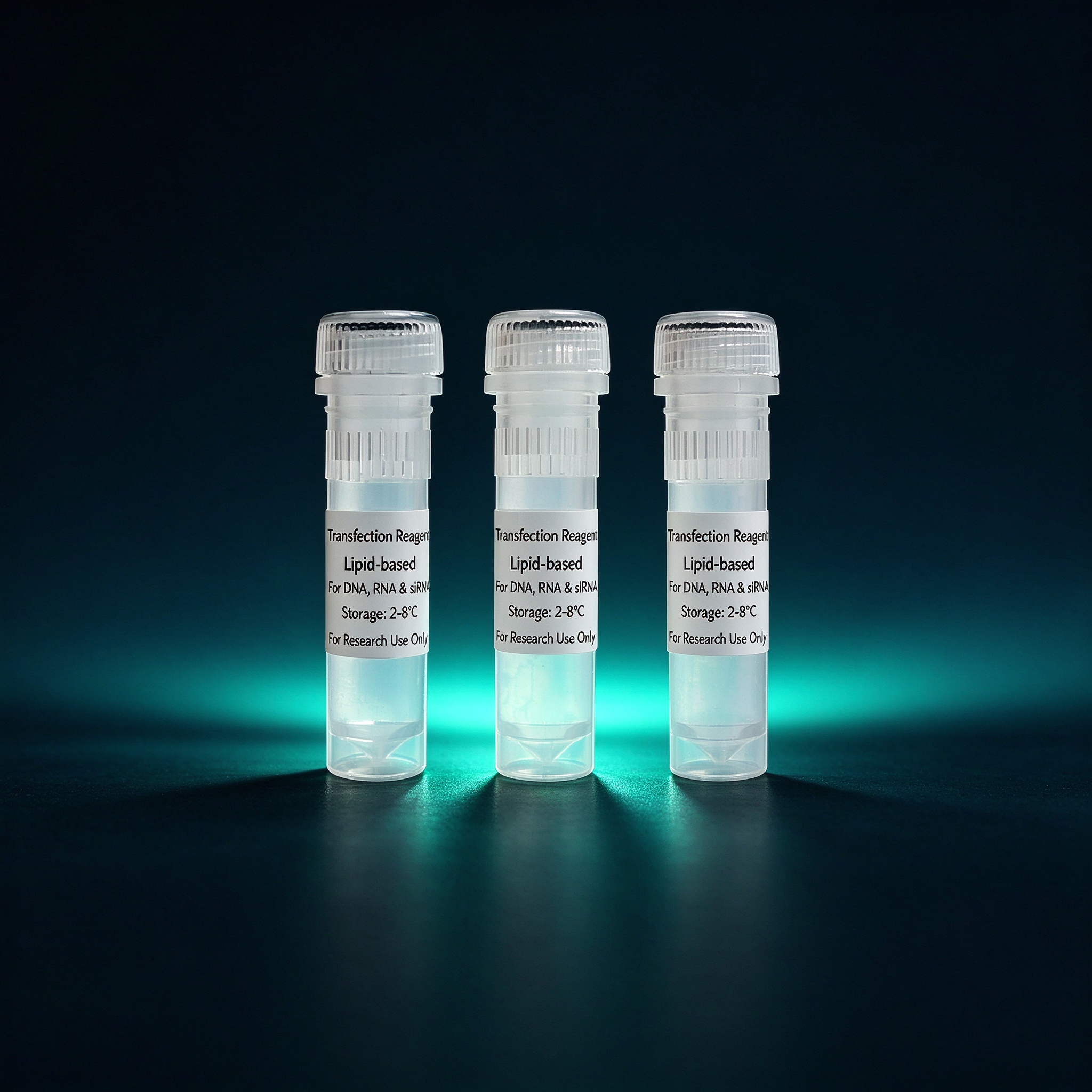
Universal Lipid-Based Transfection Reagent (In Vitro)
Broad-spectrum cationic liposome transfection reagent for plasmid DNA, siRNA, miRNA and mRNA into adherent and suspension cells — 40+ cell lines validated, serum-compatible, ~95% viability, RUO.
Catalog no. TF-LIPO-0.5/1.5/7.5 mL · Ships with certificate of analysis
For Research Use OnlyOverview
At a Glance
A ready-to-use lipid-based (cationic liposome) transfection reagent for delivering nucleic acids — plasmid DNA, siRNA, miRNA, mRNA and oligonucleotides — into cultured eukaryotic cells. Cationic lipids complex with the nucleic acid, the complex enters the cell by endocytosis, and the proton-sponge effect releases the payload into the cytoplasm. The everyday workhorse for in vitro expression, knockdown and positive-control experiments.
Key Features
- Broad-spectrum: validated across 40+ cell lines including hard-to-transfect and primary cells, in both adherent and suspension culture
- Low cytotoxicity: typical post-transfection cell viability ~95% (manufacturer data)
- Serum-compatible: transfect directly in serum-containing media — no serum-free pre-incubation, cells stay in their own environment
- All major nucleic acids: plasmid DNA, siRNA, miRNA, mRNA, oligonucleotides and nucleoprotein complexes
- Fast protocol: complex forms in ~5 minutes at room temperature — prepare and use immediately
- Familiar workflow: step-for-step compatible with leading imported lipid reagents — zero re-learning cost for existing users
Specifications
| Parameter | Specification |
|---|---|
| Technology | Cationic lipid (liposome) / nucleic acid nanocomplex; endocytosis uptake, proton-sponge endosomal release |
| Nucleic acids | Plasmid DNA, siRNA, miRNA, mRNA, oligonucleotides, nucleoprotein complexes |
| Cell types | Adherent and suspension; HEK293 / 293T, CHO, HeLa, NIH-3T3 and more, incl. hard-to-transfect and primary cells; 40+ cell lines validated |
| Transfection efficiency | >90% reported for common cell lines (manufacturer data); comparable to leading imported reagents in side-by-side testing |
| Cell viability | ~95% typical post-transfection (manufacturer data) |
| Serum compatibility | Direct transfection in serum-containing media; serum does not reduce efficiency |
| Format | Single-component ready-to-use (standard); two-component (A + B) formats available |
| Pack sizes | 0.5 / 1 / 1.5 / 5 / 7.5 mL |
| Shipping | Blue ice |
| Storage | 2–8 C, protected from light; ~1 year shelf life; most formats must not be frozen |
| Animal origin | Animal-component-free (select formats) |
| Intended use | For Research Use Only |
Protocol Timing
| Step / event | Typical value |
|---|---|
| Complex incubation | ~5 min at room temperature, use immediately |
| Optimal confluence at transfection | 70–90% |
| Protein expression (plasmid) | 24–48 h; 48 h often higher than 24 h |
| Gene knockdown (siRNA) | 3–5 days to maximal target down-regulation |
Applications
- Transient transfection: plasmid overexpression, siRNA / miRNA knockdown, in vitro mRNA delivery
- Efficient transfection of hard-to-transfect and primary cells
- Multi-plasmid co-transfection; combined plasmid + siRNA transfection
- In vitro cell validation, positive controls and formulation screening for LNP / mRNA programs
- Stable cell line construction and transient protein expression (for large-scale virus packaging or recombinant protein production, ask us about PEI-based formats)
Handling Notes
- In vitro use only — not an in vivo delivery vehicle. Transfection reagents are optimized for cultured cells; formulated LNPs are a separate product class with different QC requirements. Same physical principle (cationic lipid + nucleic acid), different job.
- Most formats must not be frozen. Store at 2–8 C protected from light — freezing disrupts the lipid structure and kills activity. Follow the lot-specific datasheet and always ship on blue ice.
- Plasmid endotoxin is the silent killer of transfection efficiency. High-endotoxin plasmid prep sharply reduces efficiency and adds cytotoxicity — always use high-purity, endotoxin-free grade plasmid. Pair with our rFC Endotoxin Detection Kit to qualify your preps before transfection.
- Handle complexes gently: no vortexing, no centrifugation — mix slowly and carefully. Form complexes in serum-free medium; avoid antibiotics in the medium during transfection.
- Optimize per cell type: optimal nucleic acid / reagent ratios vary between cell lines — run a small gradient on first use rather than a single fixed ratio.
Research Use Only
For Research Use Only. Not for clinical, diagnostic or therapeutic use, and not for administration to humans or animals.
Ordering & Documentation
Pack sizes, single- vs two-component formats, COA, MSDS, ISO documentation, FOB pricing, MOQ and lead time are confirmed per inquiry: Send us an inquiry
| Product | Universal Lipid-Based Transfection Reagent (In Vitro) |
|---|---|
| Catalog no. | TF-LIPO-0.5/1.5/7.5 mL |
| Category | Targeted Delivery |
| Documentation | Certificate of analysis provided with every lot |
| Intended use | For Research Use Only (RUO). Not for diagnostic or therapeutic use. |
Related products
Lung-Targeted RNA Transfection Kit (Ready-to-Use LNP)
Ready-to-use lung-targeted LNP kit — one mixing step, no microfluidics, no incubation, ethanol-free. Up to 94% lung accumulation after IV administration in animals. siRNA, gRNA, mRNA and circRNA compatible.
Spleen-Targeted RNA Transfection Kit (Ready-to-Use LNP)
Ready-to-use spleen-targeted LNP kit — mix, incubate 15 minutes, inject. Up to 97.60% spleen accumulation with low liver and kidney toxicity. No equipment required. mRNA, siRNA and circRNA compatible.
Lymph Node-Targeted RNA Transfection Kit (Ready-to-Use LNP)
Ready-to-use lymph-node-targeted LNP kit — mix, incubate 15 minutes, inject. Efficient expression in lymph nodes with markedly reduced off-target liver accumulation. No equipment required. mRNA, siRNA and circRNA compatible.
Get a quote for Universal Lipid-Based Transfection Reagent (In Vitro)
Specs, pricing, lead time and shipping options — usually within one business day.